Make sense of the same home appearing in different adverts
Reconcile duplicate Costa del Sol property listings: check identity, current price, inclusions, area descriptions, agency roles and conflicting information.
At a glance
- Confirm that adverts refer to the same home before merging them.
- Reconcile current prices, inclusions and the source of each description.
- Keep dated answers and unresolved questions in one candidate record.
Seeing what appears to be the same Costa del Sol home on several websites can make a property search confusing. One advert shows a lower price, another lists more floor space, and a third describes a different neighbourhood. The useful next step is to establish whether the adverts refer to the same home, which details are current and who has agreed to handle your enquiry. Several advertisements alone do not establish a problem with the property or the people marketing it.
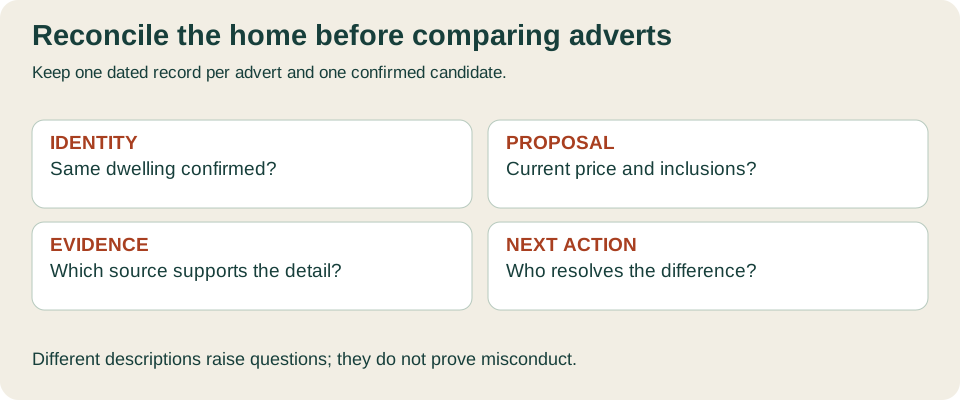
Use the listing comparison record alongside the property listing decoder. Keep original advert references and dates. The examples below are fictional and do not describe an agency, seller or current property. This approach helps organise questions before arranging repeat viewings or making a proposal; it does not replace the evidence and advice needed for a purchase.
First establish whether it is the same home
Similar photographs and room descriptions are a reason to ask a question, rather than proof of identity. A development can contain several homes with similar layouts, and a project advert may illustrate a property type rather than one specific unit. Request the advertiser’s reference, the dwelling being offered and enough location information to identify it at the appropriate stage. Record whether the photographs show that dwelling, a show home or an illustration.
Compare the room arrangement, terrace, outlook and stated inclusions. Keep uncertainty explicit: “possibly the same apartment” is more accurate than merging two unconfirmed records. Where a parking space, store or adjoining plot is mentioned, ask whether it forms part of the same proposed purchase. The Land Registry and Cadastre guide explains why matching descriptions is separate from recognising a photograph.
Ask how the enquiry will be handled
Ask the person responding whether they are the seller, the appointed marketing agent or an intermediary arranging access through someone else. Establish who will confirm availability, obtain answers and pass on an offer. This makes the communication route clear. An introduction by itself does not tell you the full scope of a service, who the client is or whether you have agreed to pay anything.
Use the estate-agent appointment guide and buyer’s agent guide for questions about representation and terms. Read a viewing form or proposed appointment before signing and ask for unfamiliar wording to be explained. If you have already contacted or viewed through another agency, mention that fact and have relevant terms clarified. A second enquiry should not be assumed to cancel an earlier agreement.
Keep one dated record for each advert
Give each advert a label and record its URL, reference, capture date, price and important claims. Note whether it states an update date and whether the person responding has confirmed the information. A search-result snippet, saved screenshot and live page can reflect different moments. A price copied into your spreadsheet also needs its source and date if it is to remain useful later.
Organise your shortlist by the actual candidate home once identity is established, retaining separate advert records underneath it. This avoids counting the same dwelling as three alternatives. The three-home comparison workspace can hold the reconciled candidate, with unresolved points in the questions field. Keep personal correspondence and private identifiers in your secure records rather than public comments or reviews.
Reconcile the price before comparing apparent bargains
A different advertised figure should lead to a precise question: what price is currently proposed for this identified home, and what does it include? Ask about parking, storage, furniture or other items mentioned in each advert. Obtain an explanation of any separate fee or charge, including who would pay it and under which agreement. Compare the complete proposal rather than choosing the smallest number.
Fictional Advert A could show an apartment at €300,000 with parking mentioned, while Advert B shows €290,000 without saying whether parking is included. These invented figures demonstrate neither a reduction nor a saving. Establish the offer and inclusions, then use the purchase cost planner for your checked assumptions. The bargain-property guide supplies the wider comparison questions.
Put floor areas and room counts on the same basis
Write down how each advert describes area: built, usable, terrace, plot or another measure. Do not silently replace those labels with “size”. Ask which document or measurement supports the number and which spaces are included. A room used as an office in a photograph needs to be distinguished from the property description and your intended use. The comparison starts with consistent definitions.
If a difference matters, ask an appropriate professional to reconcile it using relevant records and the inspection scope. The survey and inspection guide helps frame that appointment. An advertiser’s explanation and a professional finding are different entries in your record. Keep both with their dates rather than treating the most detailed-looking advert as automatically correct or dismissing a difference as unimportant.
Separate the location label from the actual approach
One advert may use a municipality, another a development name and another a broad coastal description. Ask for the location relevant to the candidate and test the actual route when access is arranged. Beachside, golf area or near amenities does not establish the walk, road crossing, gradient or service pattern you would use. Compare practical details rather than settling the search from a map pin.
Use the area comparison checklist and year-round viewing guide for ordinary journeys and visit conditions. A broad location marker can protect a seller’s privacy, but it leaves questions to resolve before your decision. Ask when more precise information can be supplied rather than filling the gap with assumptions about the neighbouring street or development.
Know which information to request
Andalusia’s official consumer questions on home purchases distinguish new-home marketing information from the information sheet associated with professional intermediation in later sales. Ask which information applies and obtain help understanding it. This guide does not turn an advert into prescribed information or assess an individual business’s compliance. Keep the relevant original paperwork separate from your summary.
The Registrars’ explanation of property information describes the informative purpose of a nota simple. Have current material interpreted for the identified home. The document reading examples distinguish an advert, a registry extract and other records. They do not establish ownership, condition or the complete transaction position simply because similar wording appears in several places.
Resolve conflicting answers before a commitment
Send a concise list of discrepancies to the enquiry coordinator. Ask for a written answer identifying the home, current price, inclusions and source of the corrected description. If answers remain inconsistent, record who is obtaining clarification and when you will review it. A seller can consider proposals while questions are open; your timetable should still reflect the information you need and the commitments being proposed.
Before paying or signing, take unresolved identity, authority, fee or inclusion questions to your independent legal adviser. Review the reservation guidance for questions about a proposed payment and its conditions. Do not turn a discrepancy into an accusation or treat a reassuring telephone call as a substitute for the terms and evidence relevant to the transaction.
Finish with one candidate and an evidence trail
Mark important points as confirmed, reported or unresolved, with sources and dates. Retain superseded prices to explain how a proposal changed, but use the current agreed basis for your budget. The purchase decision guides help when an answer changes the shortlist. Before a repeat viewing, identify which new question it will answer and who has arranged access.
After the visit, update one record rather than creating disconnected notes. This gives your household and advisers a shared starting point while leaving conclusions to the relevant appointments. Keep corrections attached to earlier versions so that a later decision can be understood. Sources were checked on 9 November 2026; this guide was prepared for publication on 10 November 2026.