Know the next question when a purchase assumption changes
Use six practical decision guides for valuation changes, delayed finance, missing records, unexpected work, unclear access and proposed community projects.
At a glance
- Identify what changed and the evidence supporting the new information.
- Allocate the question to the appropriate professional appointment.
- Review the affected decision without assuming a standard legal outcome.
A property purchase can change direction when new information arrives. A valuation may differ from the proposed price, finance may remain conditional, a survey may identify work or a document may not explain what you expected. The useful response is to identify the exact uncertainty and the decision it affects, rather than treat every change as either a disaster or a routine detail.
These six decision guides organise questions for a Costa del Sol purchase. They do not interpret an individual agreement, give an automated legal conclusion or recommend that you buy or withdraw. Use the decision log to record the evidence, responsible person, next action and advice needed before a commitment.
Use the same four questions for every change
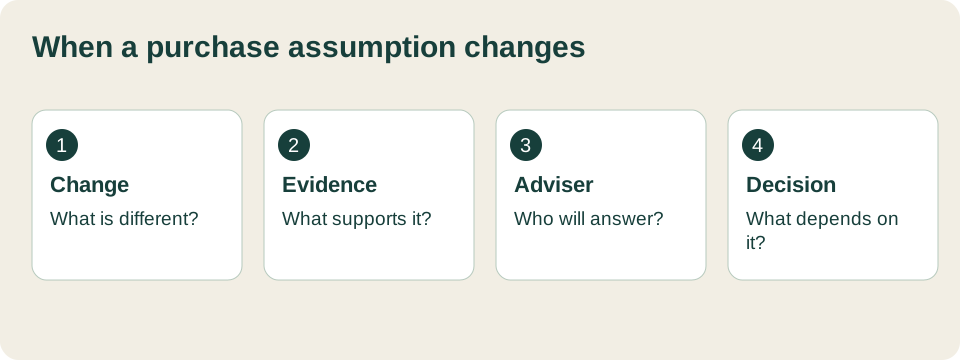
Ask what has actually changed, which information supports it, who has agreed to advise on it and what decision depends on the answer. Keep the date and complete source, not just a shortened message. Separate a confirmed finding from a possibility, a marketing statement or an observation made during a viewing.
The document library helps identify the different records, while the professional roles guide helps assign the question. If your existing appointment excludes the matter, agree how it will be handled before assuming that someone else is already investigating it.
Guide one: the valuation differs from the proposed price
Start by establishing what the valuation report says and what the lender has actually communicated. The report, the asking price, the proposed purchase terms and the lender’s decision are separate pieces of information. Banco de España’s valuation guidance explains its relevance to mortgage lending; it is not simply an administrative step.
Ask the lender or appointed intermediary to explain the financing position and any outstanding requirements. Ask your lawyer how the actual purchase terms relate to that position. Update the funding comparison only with clearly labelled assumptions or confirmed information. Do not assume that a different valuation automatically changes the agreed price or releases a party from an agreement.
Continue with mortgage valuations and finance conditions. Record whether a revised price, more information or a different funding plan is being discussed, and who must explain the consequences before you act.
Guide two: financing is taking longer than expected
Identify which stage remains open: information supplied, assessment, valuation, documents, signing arrangements or another requirement described by the lender. A general message that the application is progressing does not establish which conditions have been satisfied. Request a precise update and keep it separate from your own hoped-for completion date.
Put the financing update alongside the actual purchase agreement and dates, with your lawyer’s advice. If a change to timing is proposed, ask how it should be documented and agreed. Do not infer an extension or a cancellation right from the fact that a mortgage decision is still outstanding.
The private purchase contract guide and process overview provide context. Your next action might be to supply a missing item, obtain a clearer lender response or ask for advice on a proposed change. The correct sequence depends on the actual transaction.
Guide three: a document is missing or inconsistent
Name the record and the discrepancy precisely. Is it an identifier, description, ownership entry, date, associated space or something else? Record which versions you hold and whether they are complete originals, translations or extracts. Give the relevant adviser the whole documents so the issue can be considered in context.
Use the Land Registry and Cadastre guide to prepare the questions. The official registry service explains the property information available through its procedures. The existence of one record does not answer every question about the physical home or intended use.
Ask who will obtain the missing material and what decision must wait for an explanation. Avoid treating a verbal assurance that a record can be supplied later as the same thing as receiving and reviewing it. Update the enquiry log when the answer arrives, including any limits that remain.
Guide four: an inspection identifies unexpected work
Read the finding with its scope, access limitations and recommended next investigation. Is it an observation requiring more assessment, a maintenance recommendation or an estimate based on assumptions? Ask the technical professional to explain unfamiliar wording and what evidence is needed before pricing or designing a response.
Separate the assessment of condition from the commercial proposal to carry out work. The inspection guide and renovation budget guidance help organise those stages. Where permissions, shared elements or responsibility may be involved, allocate the corresponding legal and administrative questions as well.
Then consider what the information changes in your budget, intended use and discussion of terms. A quotation is not itself an agreement by the other party to pay for work. Have any proposed transaction change explained and documented appropriately rather than relying on an informal understanding.
Guide five: access or an associated space is unclear
Describe what you saw and what you were told: a route, parking space, store, terrace or another part of the proposed purchase. Ask which documents and arrangements relate to it. The fact that a route was open during a viewing does not explain the legal basis, maintenance responsibility or practical availability for your intended use.
The boundaries and access guide and ownership rights guidance help you frame the enquiries. Give your lawyer the actual description and supporting records, and obtain technical or practical advice where the question goes beyond the legal documentation.
Record why the point matters. If regular vehicle access, delivery arrangements or a particular outdoor space is central to the brief, make that dependency explicit. Keep the entry unresolved until the appropriate explanation has been supplied; do not let a convenient photograph stand in for it.
Guide six: shared building work enters the conversation
Ask whether the work has been discussed, investigated or agreed, and request the records supporting that description. Identify any later meeting, specification or communication that changes the position. Do not turn an informal reference to a roof, lift or façade project into a guessed personal contribution.
Use the community assessment example to connect accounts, minutes, proposed work and sale-specific questions. Your lawyer should explain the transaction position, and a suitable technical professional should address building questions within the agreed scope. The administrator can help clarify relevant records and operating arrangements.
Update the ownership assumptions separately from the legal enquiry. A budget can include an explicitly hypothetical allowance while the actual position remains unresolved, but that allowance must not be presented as evidence of the amount or obligation. Keep the source, period and status of each figure visible.
Return to the shortlist with a clear record
Use the comparison workspace to update the homes on the same basis. Record what you now know, what remains a statement and what still needs checking. If an assumption has changed, retain enough context to explain why the shortlist or budget is different from your first version.
For British buyers, the UK government’s Spain property guidance provides background on independent advice. Sources were checked on 9 November 2026. The decision sequences are original enquiry frameworks, with no promise of a refund, extension, legal outcome or successful purchase.
At the next review, record whether the question is open, answered with limitations or resolved for the decision in hand. Note the evidence rather than deleting the original issue. This preserves a useful history if the proposed price, intended use or timetable changes again, and makes it easier to explain why a further professional enquiry is needed.