Know who is doing what in your property purchase
Understand the roles of agents, lawyers, notaries, technical professionals, mortgage intermediaries, tax advisers and managers in a Costa del Sol purchase.
At a glance
- Identify the client, agreed scope, fee and exclusions for each service.
- Distinguish introductions from appointments and specific deliverables.
- Keep important questions and handoffs visible before making decisions.
A Costa del Sol purchase can involve several professionals, each with a different appointment. The useful question is not simply who is present, but who has agreed to do which work for you. An introduction, a familiar job title or a helpful conversation does not describe the complete scope of a service. Written appointments and clear handoffs make the process easier to follow.
This guide maps the main roles without ranking companies or recommending an individual provider. Use the appointment questions worksheet to record the client, service, fee, exclusions, deliverable and next contact for each person. Link those appointments to the stages in the buying process guide.
Start with the client and the agreed service
For every appointment, establish who the professional represents, who pays and whether any other payment or referral arrangement is relevant. Ask how conflicts are identified and how communications will be handled. A provider may offer several services, but that does not mean every service is included in the particular appointment you are considering.
Use a short written brief describing the property, your proposed use and the questions that matter most. Ask for the service boundaries in plain language. If legal, tax, building and management work are being offered together, identify the person responsible for each part and how their conclusions will reach you before the relevant decision.
The estate agent and the marketing appointment
An estate agent may help bring parties together, arrange viewings, communicate offers and organise information within an agreed service. Ask whom the agent acts for in the proposed transaction and how their appointment is structured. Do not assume that help with paperwork means you have appointed an independent lawyer or commissioned a technical investigation.
The estate-agent appointments guide covers questions about services and terms. The existing Costa del Sol agency list is a starting point for research, not a quality ranking or endorsement. Compare actual proposals and relevant experience rather than treating a company name as a complete description of the work.
The buyer’s agent and the search brief
If you appoint a buyer’s agent, define the search area, property requirements, shortlist process, fee and point at which any payment becomes due. Ask what happens with a property you have already found, how introductions are recorded and whether the service includes negotiation or coordination after an offer. Clarify relationships with sellers and other agents.
The buyer’s agent guide helps structure the comparison. Write down the evidence you expect for a shortlist: address-level access, comparable assumptions, known limitations and questions still open. A search service can be useful without supplying the separate legal, mortgage or building advice you may need.
Your independent lawyer and the legal brief
The UK government’s Spain property guidance recommends independent legal advice and checking the professional’s relevant standing and experience. Explain the intended purchase, funding, ownership and use of the home when asking for a proposal. Make sure the appointment addresses your own circumstances rather than an assumed standard transaction.
Ask what enquiries will be undertaken, which documents will be explained, what the proposed contract review includes and how findings will be reported before you commit. Use the lawyer appointment guide and the due diligence framework. Agree separately whether tax, succession, disputes or other specialist work is included or needs another adviser.
The notary and the formal transaction
The notary has a public and impartial role in the formal process, distinct from a private appointment to represent one party’s interests. Ask your own adviser to explain what will be prepared for the signing, what you need to understand in advance and how interpretation or representation will be arranged where relevant. Do not rely on a last-minute signing visit to resolve every earlier uncertainty.
The completion-day guide helps you prepare the practical sequence. The Spanish consumer ministry’s explanation of public deeds and private sale agreements provides context for discussing the form and effect of the actual transaction with your adviser.
The surveyor or technical professional
Choose a suitable technical appointment for the building questions you have. Specify whether the brief concerns visible condition, damp, structure, services, shared elements or proposed work. Ask what access is needed, which areas are excluded, whether testing is included and what form of report you will receive. A short inspection description should not leave you guessing about its limitations.
Use the survey and inspection guide and technical professional appointment guide. A mortgage valuation and an investigation of building condition have different purposes. If both are relevant, ask what each covers and avoid assuming that one supplies the findings you expected from the other.
The lender, valuer and mortgage intermediary
Keep the lender’s decision, the valuation and any intermediary’s service separate in your notes. Ask the intermediary which service is offered, how fees are explained and what information is required. Ask the lender or adviser to clarify the steps still outstanding before you base purchase commitments on financing you expect to obtain.
The Banco de España registers page provides official registration information and links to the relevant competent bodies. Check the applicable registration for the activity rather than assuming every intermediary belongs in the same register. Read the finance conditions guide and valuation guidance alongside your own proposed loan documents.
The tax adviser and the individual circumstances
Tell the tax adviser about the facts that may affect the enquiry: residence, ownership shares, financing, proposed letting and any eventual sale plan. Ask which jurisdictions and filings the appointment covers, what records you must supply and whether advice is a one-off piece of work or an ongoing service. Keep assumptions visible when comparing proposals.
The property tax and cost guides can help you frame questions, but do not establish your individual position. If you are planning rental income, ask for the relevant model to be considered explicitly. A general purchase-cost estimate should not silently become an assessment of every later ownership or rental obligation.
The community administrator and property manager
Community administration and management of your own home are different appointments. Ask the community contact how to obtain the relevant records through the appropriate process. For a private property manager, agree inspections, reporting, spending authority, access arrangements and what happens in an emergency. Clarify which services require separate contractors or approval.
The community assessment and property manager comparison give you separate question sets. If the home will be rented, define the rental model and the management work involved rather than assuming an occasional inspection service includes every operational responsibility.
Make the handoffs visible
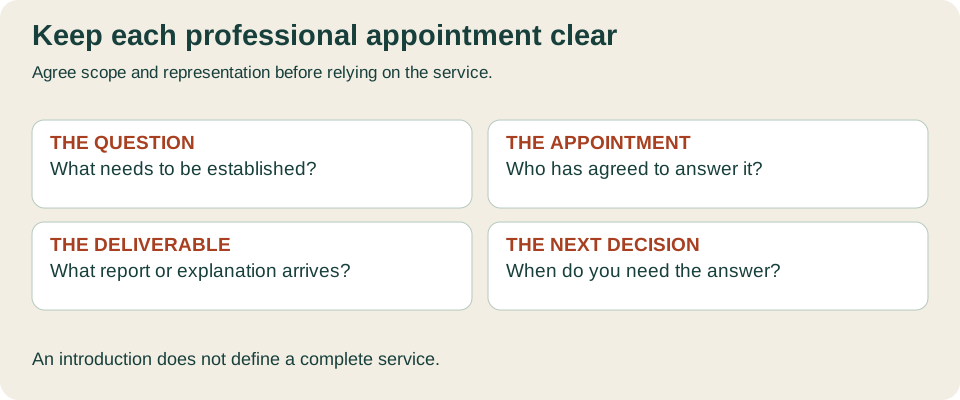
Keep a shared question log under your own control. Record the issue, responsible person, information requested and the decision it affects. A technical finding may create a legal question; a funding condition may change the timetable. Ask how the relevant professionals will communicate with your permission so those dependencies are addressed before they become urgent.
When an answer arrives, record whether it resolves the question or leads to another enquiry. If a report excludes a particular matter, allocate it explicitly. This is especially useful for a remote purchase, where helpful messages can otherwise give the impression that work has been completed without a clear deliverable.
Compare proposals on scope as well as fees
Put proposals alongside each other using the same headings: client, work, exclusions, fee basis, additional charges, expected deliverables, communication and complaints process. Ask for clarification where a term is unclear. Keep the accepted version and any later changes with the purchase records. Choosing carefully is easier when each service can be described in a few precise sentences.
Source pages checked on 9 November 2026 include the government and Banco de España guidance linked above. Company lists elsewhere on this site remain research aids without company contact details or external company links. No provider is endorsed, and no independent professional review of this guide is claimed.
Allocate the changed question clearly
You can assign the next enquiry with the decision guides. Record the issue, complete evidence, agreed professional scope and decision requiring the answer. An introduction is not the same as a commissioned investigation or a completed deliverable.