Look beyond the apartment to the community behind it
Use a fictional community example to connect accounts, meeting minutes, maintenance plans and adviser questions before buying a Costa del Sol home.
At a glance
- Separate money charged, receipts, cash and spending commitments.
- Connect meeting records with the work and funding being discussed.
- Allocate legal, financial-record and building questions to the right people.
Buying an apartment on the Costa del Sol means assessing the shared building and its organisation alongside the home itself. A smart entrance, attractive pool and modest advertised community fee are useful observations, but they do not explain the accounts, maintenance decisions or work that owners may be discussing. The practical task is to connect those records with your proposed purchase.
This guide follows an entirely fictional community. It shows how to organise questions, not how to certify that a community is financially or legally sound. Use the community assessment worksheet with the community ownership guide and arrange appropriate checks on the actual home.
Ask for a connected set of records
Start with the relevant accounts, budget, meeting minutes, information about planned work and the transaction-specific records your lawyer requests. Ask which period each document covers and whether later decisions or correspondence change it. A collection of old papers can look comprehensive while omitting the item most important to the purchase.
Use the illustrated document library to distinguish the purpose of accounts, minutes and other records. Your solicitor should identify what is needed for the transaction and explain the legal significance of any missing material. Keep a separate list of technical questions for an appropriate building professional.
Follow the money in the fictional example
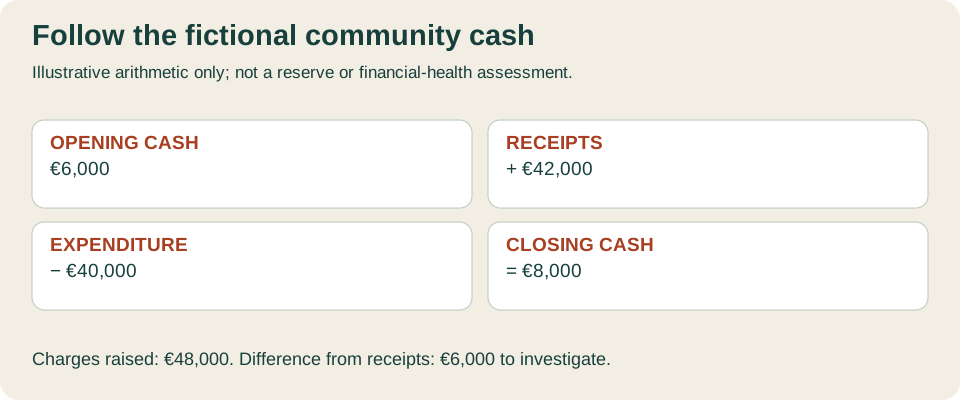
| Item | Amount | Question to ask |
|---|---|---|
| Opening bank balance | €6,000 | Does it reconcile with the opening statement? |
| Charges raised | €48,000 | What was charged, and to which period? |
| Receipts collected | €42,000 | Which payments remain outstanding? |
| Cash expenditure | €40,000 | Are there additional unpaid invoices? |
| Closing bank balance | €8,000 | What existing commitments does this cash need to meet? |
The cash movement is €6,000 plus €42,000 minus €40,000, leaving €8,000. The difference between charges and receipts is €6,000 in this deliberately simplified example. Neither calculation tells you whether the community has met its legal obligations, whether all costs have been recorded or what an individual owner will owe.
Separate cash, arrears and spending commitments
Ask how the accounts distinguish money in the bank, sums owed by owners and bills that still need paying. A reported balance can mean different things in different summaries. Request an explanation of the terminology and the connection between the accounting records and the bank position, rather than assuming that every available-looking euro can fund new work.
In our example, the next useful question is why receipts are lower than the charges raised. You would also want to know whether any receipts relate to an earlier period. These are enquiries for the actual records, not evidence of a problem in a real development. The ownership budget tool can hold your confirmed assumptions once the figures have been explained.
Read the minutes as a sequence
Suppose the fictional minutes mention recurring water ingress and an agreement to obtain a technical assessment and quotations for roof work. That is different from a fully specified project with a selected contractor, settled funding and an agreed timetable. Ask for the actual recorded decision, supporting papers and any later steps. Keep discussion, investigation and commitment separate in your notes.
The meetings and voting guide provides context for the records. Your lawyer should advise on the significance of the actual decisions and the position affecting your purchase. Do not infer an individual contribution, a voting outcome or a binding obligation from a short marketing description of the meeting.
Connect visible condition with the maintenance plan
Walk through the shared spaces you would use: entrances, lifts, stairs, corridors, parking, gardens and any leisure facilities. Note the condition and how access works. Ask whether maintenance observations already appear in the records. A freshly decorated lobby and an ageing service installation are separate matters; neither should stand in for a review of the other.
Take technical concerns into the survey and inspection brief. Explain whether you need advice on the private home, visible common elements or a proposed project, and agree the scope. Do not assume a standard inspection automatically covers every shared installation or supplies access to all relevant records.
Establish which property and which obligation are involved
A development may be described in a listing using a familiar name while the transaction involves particular legal entities, units or associated spaces. Ask your adviser to identify the relevant arrangements for the dwelling, parking and storage you intend to buy. Match the documents with that purchase before using the advertised fee in your budget.
The shared and private repairs guide helps frame responsibility questions. A roof terrace or parking area may need its own explanation concerning use, ownership and maintenance. Record the answer and its documentary basis rather than relying on how other owners appear to use a space.
Keep the sale-specific checks distinct
Article 9 of the Horizontal Property Act addresses community-debt information in a sale. Ask your lawyer to obtain and explain the appropriate transaction evidence and advise on the implications of any proposed waiver. An informal statement that the seller pays regularly should not be treated as the entire enquiry.
Keep that check separate from the broader assessment of future expenditure and building condition. A record concerning one owner’s position cannot explain every maintenance proposal or the state of shared equipment. The legal checks framework helps keep the different enquiries together without confusing their purposes.
Compare fees with the services actually provided
List the services and facilities included in the confirmed charge: administration, cleaning, grounds, lifts or other shared provision as applicable. Then identify charges paid separately and possible future expenditure that has not been settled. Compare two properties using the same categories. A smaller fee and a larger service offering cannot be assessed without looking at funding and scope.
Use the apartment comparison guide or gated-community guide to relate that service package to your own needs. A facility you rarely use may still form part of the ownership arrangement. Confirm the actual position before treating it as an optional personal expense.
Allocate each unanswered question
The administrator can help explain community records and operating arrangements. Your lawyer considers the transaction documents and legal questions within the agreed appointment. A suitable technical professional investigates building or installation concerns within their scope. Agree what each person will provide, and keep the answers in one enquiry log so a handoff does not disappear between appointments.
The professional roles map is useful here. For example, an unanswered question about a repair contribution may involve both the underlying decision and a technical assessment of the proposed work. Ask for the relevant parts from the right people; do not expect one short answer to cover everything.
Make the second viewing an evidence review
Return with the documents you have received, the questions still open and a budget based on clearly labelled assumptions. Ask what has changed since the first viewing. If a purchase depends on a particular answer about work, payments or use, discuss that dependency with your adviser before agreeing terms. The objective is a clearer decision about this home and community.
Source context was checked on 9 November 2026 against the official consolidated Horizontal Property Act, including the framework for community administration. The fictional amounts are original arithmetic examples. They are not a benchmark for fees, arrears, reserves or investment quality on the Costa del Sol.