Understand the paperwork behind your property decision
Explore six clearly labelled teaching examples covering registry information, community records, IBI, energy documentation and reservation proposals.
At a glance
- Match each record to the property, date and question it should answer.
- Explore six original teaching cards with accessible explanations.
- Keep requested, received and adviser-reviewed documents separate.
Property paperwork becomes easier to use when you know what question each document is meant to answer. For a Costa del Sol home, a registry extract, an energy certificate and community meeting minutes serve different purposes. Keeping them in one folder is useful; treating them as interchangeable evidence can leave important gaps.
This library contains six original teaching examples. They are simplified reading prompts, with invented details, rather than copies of official documents or forms for signature. Use the document reading worksheet to keep your own questions, and read the legal checks guide for the wider purchase process.
Build an index before interpreting the paperwork
For each record, write down its name, issuer, date, property identifier and the question you expect it to answer. Note whether you hold a complete copy, a translated version, a summary or only an assurance that it exists. Keep the original alongside any translation. A file called “all documents” is less helpful than an index showing what has actually been supplied and reviewed.
Use three progress labels: requested, received and reviewed by the appropriate adviser. A received file has not necessarily been checked. The professional roles guide helps you assign the enquiry rather than expecting one person to cover every legal, technical and tax issue.
Example one: the nota simple
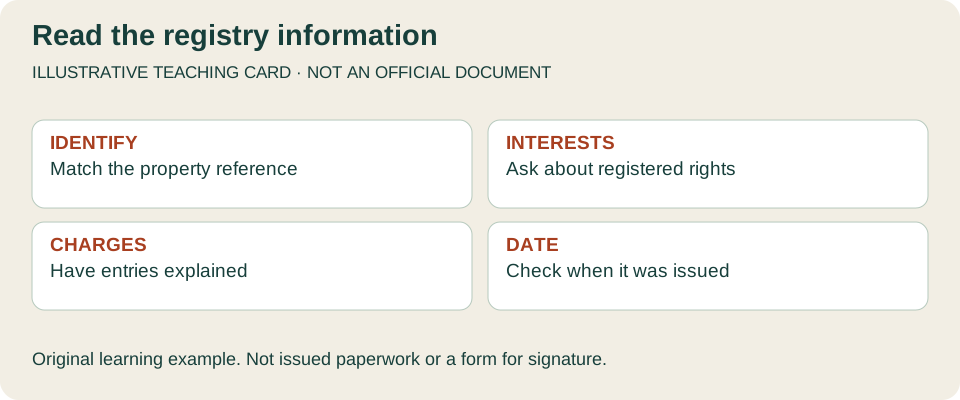
Fictional reading card: property reference EXAMPLE-01; registered interest shown as ownership; a charge entry is present; extract issued on the date shown on the record.
Begin by matching the record with the property being discussed. Ask your lawyer to explain the interests and entries, including any charge, rather than assuming that a familiar seller name settles the position. The Registradores’ explanation of registry information distinguishes the description, ownership and possible charges and explains the different evidential role of a certification.
Check when the information was issued. A copy supplied early in the search does not remove the need for appropriate checks later. Continue with the nota simple guide and existing charges and mortgages. The teaching card deliberately does not imitate official wording or certify a real property.
Example two: community accounts
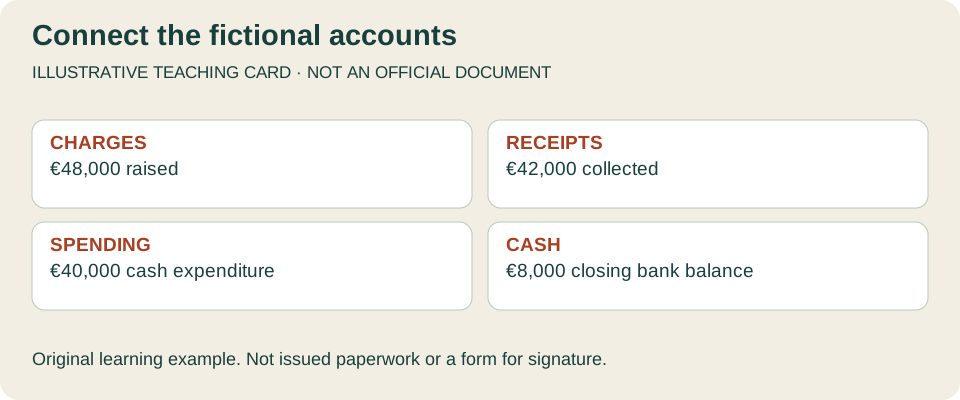
Fictional reading card: annual charges €48,000; receipts €42,000; expenditure €40,000; opening bank balance €6,000; closing bank balance €8,000. Charges less receipts leave €6,000 to investigate.
Ask which period the accounts cover and how the figures relate to the bank balance, outstanding payments and unpaid owner charges. Money charged is not necessarily money collected. A cash balance also needs context: there may be invoices awaiting payment or work already agreed. These simplified numbers are a reading exercise, not a model of a well-funded community.
Use the worked community assessment to follow the same fictional figures into practical questions. Your own transaction needs the actual records and an explanation of the obligations relevant to the property. Do not use this example to decide whether a community’s statutory requirements have been met.
Example three: meeting minutes
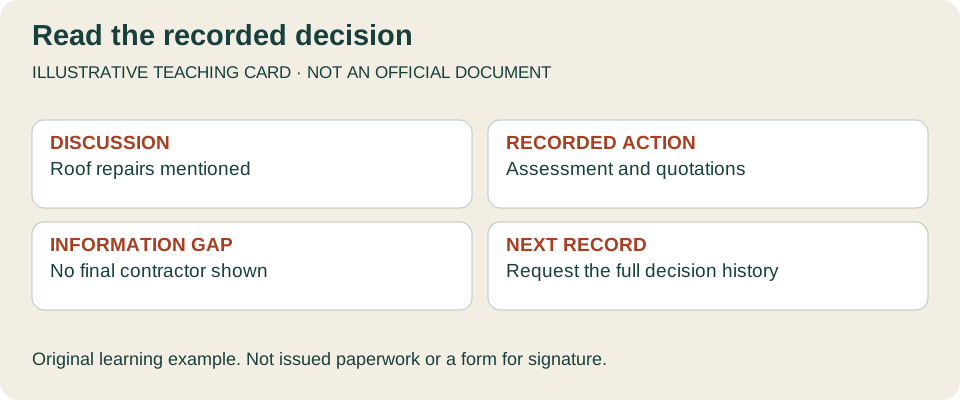
Fictional reading card: owners discussed roof repairs; the recorded action was to obtain a technical assessment and quotations; no final contractor or allocation is shown in this extract.
Read beyond a statement that work was “mentioned”. What does the full record say was decided, and what happened next? Ask for the supporting information and any later meeting or communication that changes the picture. The example leaves a deliberate information gap: you cannot calculate your future contribution from this short extract.
The community meetings guide explains the wider subject. For responsibilities concerning physical work, use shared repairs and private elements. Have legal questions about decisions and obligations considered against the actual documentation and circumstances.
Example four: an IBI payment record
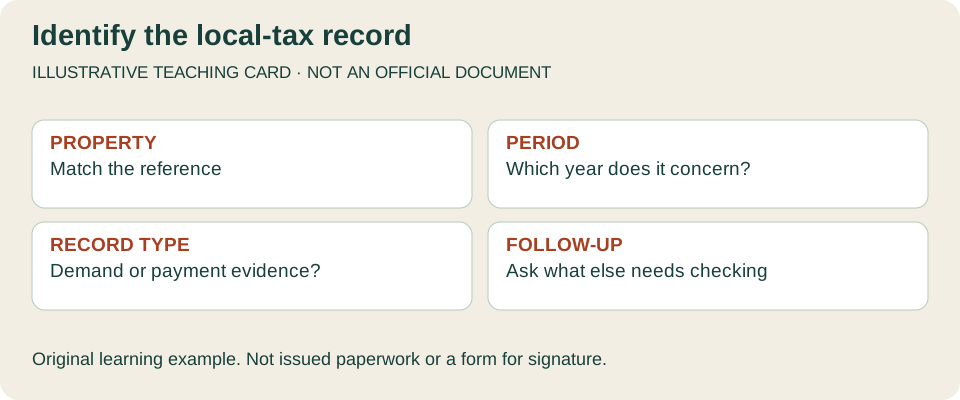
Fictional reading card: a local-property-tax document identifies a property reference, a particular annual period and an amount; a separate payment record is supplied.
Match the reference and period before drawing a conclusion. Ask whether the paperwork is a charge notice, payment evidence or another kind of record. A payment relating to one period does not itself describe every other liability or the allocation of costs between buyer and seller. Keep any proposed adjustment separate from proof that a payment occurred.
Use the IBI and local charges guide to prepare the relevant questions. Request current information from the appropriate authority or adviser for your property. This teaching example includes no tax rate, valuation or assurance that a real account is clear.
Example five: energy documentation
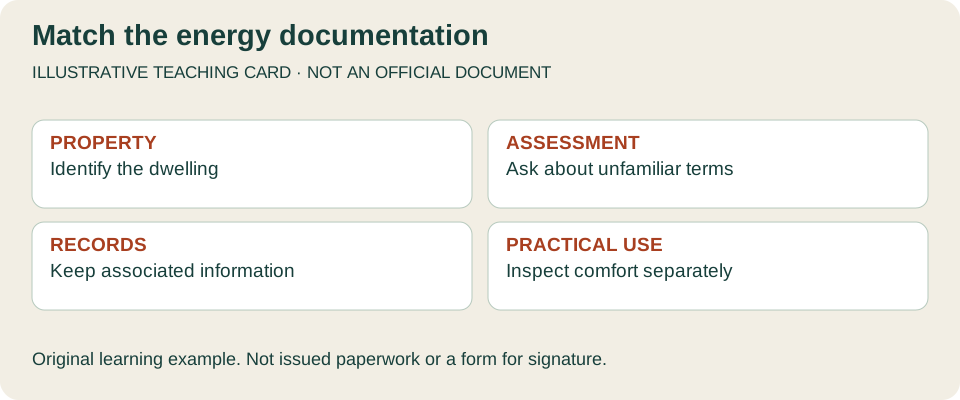
Fictional reading card: the document identifies the dwelling, an assessment and accompanying information; the reader checks that the supplied record belongs to the home being offered.
The energy ministry’s certification guidance explains the framework for documentation in sales and rentals. Ask a suitable technician about unfamiliar assessment terms and recommendations. Keep the certificate, its associated information and any improvements completed since the assessment together.
The energy certificate guide connects this paperwork with the transaction. Your own questions about heating, cooling, shading and condition still matter. A label cannot tell you what another household will spend or replace a building inspection.
Example six: a reservation proposal
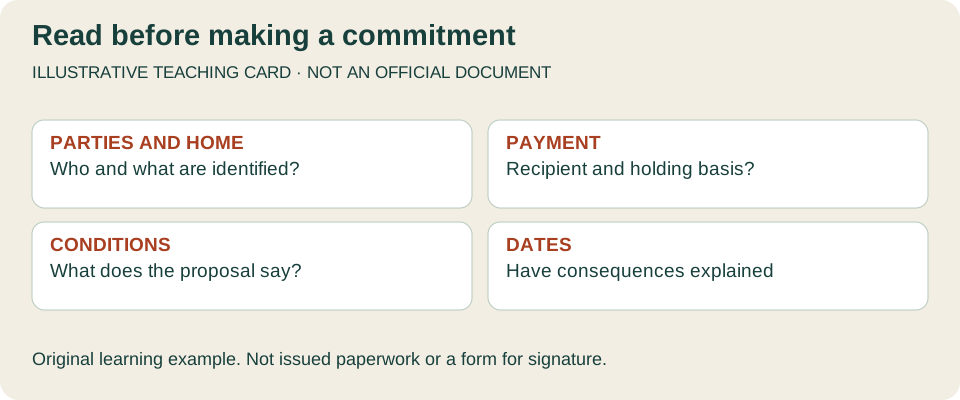
Fictional reading card: a proposal names parties and a property, requests a payment, refers to conditions and sets dates. The reader has not yet established the consequences of signing or paying.
Have your own adviser explain the complete proposed terms before making a commitment. Identify the recipient of money, the basis on which it is held and the consequences attached to the circumstances described in the proposal. A heading such as “reservation” is not enough to understand an individual agreement.
Use reservations and arras guidance with secure payment preparation. This library intentionally provides no model cancellation clause, refund promise or contractual shortcut. Those questions need the complete agreement and advice for the actual transaction.
Handle translations and short extracts carefully
If you receive a translation, keep the corresponding original and identify who prepared it. Ask your adviser about any term whose meaning affects the transaction. A convenient English label can hide distinctions between the kinds of records being discussed. Record the page or section containing the issue so the person reviewing it can find the whole passage and its context.
When someone sends only a selected extract, ask whether additional pages, annexes or later records are needed. In the fictional roof-work example, a short paragraph does not supply the full decision history. In the reservation example, a payment line cannot explain the entire agreement. Make the missing material visible in your index and agree who will request it before the relevant purchase decision.
Keep a record of what the examples cannot establish
A useful document index includes an unresolved-questions column. Record discrepancies in names, descriptions, dates or supporting records, and ask who will reconcile them. Give your advisers the whole record rather than an isolated photograph of the section you recognise. Share personal and financial information through an agreed appropriate channel, with unnecessary material removed where suitable.
Sources checked on 9 November 2026 include the official registry service, the Horizontal Property Act and the Junta’s purchase-document guidance. These sources explain context; the six cards remain original fictional teaching material.
See when the records affect a decision
You can connect the paperwork with the worked purchase scenarios. The examples show how a missing explanation can change a next step. Keep the purpose and limits of each record clear rather than treating a folder of documents as a completed investigation.