Turn a property listing into questions you can check
Decode Costa del Sol property listings using fictional examples, practical questions and evidence checks for area, views, condition and investment claims.
At a glance
- Separate marketing claims from observations and supporting records.
- Compare floor areas and included spaces on a consistent basis.
- Use three fictional listing examples to prepare your own enquiries.
A Costa del Sol listing is a starting point for a conversation. Its photographs, headline and short description help you decide whether a home deserves a viewing, but they rarely answer all the questions behind a purchase. A useful approach is to turn each attractive claim into something you can check: the location, the space, the condition, the documents and the complete cost.
This decoder uses three original fictional descriptions. They are teaching examples, with no connection to a property currently for sale. Read them alongside the property viewing checklist, then download the listing questions worksheet to record what remains unresolved.
Separate the description from its supporting evidence
Make three columns in your viewing notes: what the advertisement says, what you have observed and what still needs independent checking. Keep the date and source of each answer. An agent’s explanation can be helpful without settling a technical question or replacing the documents your lawyer needs. An image can show an appealing room while leaving its orientation, measurements or permitted use unclear.
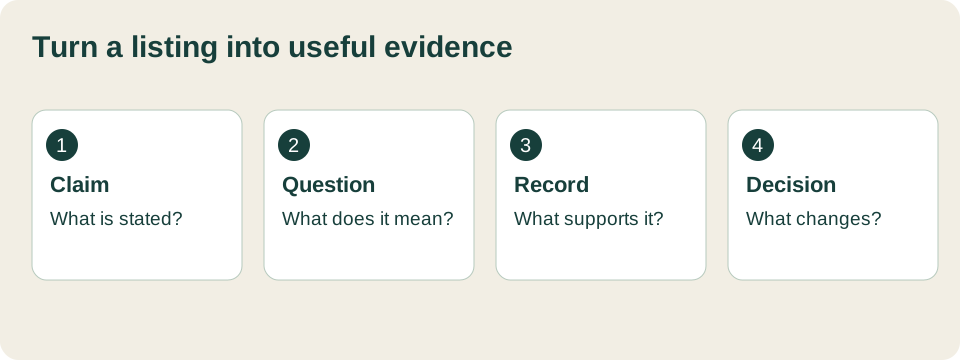
If the information changes between the portal, an agency website and a viewing, ask which version is current. Save your own dated notes rather than treating an old screenshot as a final specification. The offer preparation guide helps you connect unanswered questions with the point at which you would make a commitment.
Example one: the beachside apartment
Illustrative listing: “Bright two-bedroom apartment, 95 m², beachside location, sea views, walking distance to everything, ideal holiday home.”
There are several separate claims here. Does the floor area describe internal usable space, built space, terraces or an allocation of common areas? From which room or terrace is the sea visible? What does the advertised location mean for the actual route to the beach? What would “everything” include for your household in February as well as during a summer visit?
Request a floor plan with its measurement basis, the exact entrance location and a list of what is included. Walk to the destinations you would use, including the return route with shopping. Read the coastal property guide and sea-view comparison before assuming that two similarly described homes offer the same setting.
Ask which square metres are being compared
Do not compare price per square metre until the underlying areas are comparable. Spain’s cadastral publications illustrate how recorded built area can include different components, including associated spaces and common elements. That makes a label and a number insufficient on their own. Ask for the breakdown rather than applying a guessed percentage to convert built area into usable space.
For each home, record the stated internal area, terraces, parking, storage and any common-area allocation separately where the documents identify them. Use the Land Registry and Cadastre guide to organise discrepancies. Measurements, legal descriptions and what is actually being sold need to be reconciled for the specific property.
Example two: the bargain finca
Illustrative listing: “Reduced rural villa with extensive land, guest accommodation, private water supply and excellent rental potential. A genuine bargain.”
The useful questions begin with the entrance, the boundaries and the buildings. Who controls the approach? Which structures and uses are described in the available records? What exactly is the water arrangement, what evidence supports it and who maintains the equipment? A photograph of an additional room does not establish the position of separate guest accommodation.
Use the rural homes guide and access and boundary questions to prepare the enquiries. A reduced asking price should also be examined through the bargain-property checklist. Compare the complete purchase and ownership commitment, including work identified during inspection.
Translate investment language into a scenario
“Rental potential” does not specify an operating model, an achievable rent or the costs of delivering it. Ask whether the figures are actual records, a marketing estimate or a projection. Establish the period covered, the assumed occupancy, personal use, management, maintenance and any permissions on which the proposal depends. Keep gross receipts separate from the amount left after expenditure.
The investment projection guide gives you a structure for testing those assumptions. If a listing mentions an existing rental registration or licence, have your adviser check the exact record and its relevance to your intended use. Do not assume that an advertisement settles regional, municipal, community or ownership questions.
Example three: the off-plan home
Illustrative listing: “New luxury development with panoramic views, premium finishes, completion expected next year and a flexible payment plan.”
Separate the proposed specification from the finished building you would eventually receive. Which drawings and finishes form part of the agreement? What do the payment stages depend on? How are proposed changes handled? Ask your lawyer to explain the documents and protections for the transaction before relying on a sales presentation or paying a reservation amount.
Compare the off-plan purchase guidance with the luxury property checklist. The word “luxury” cannot tell you which appliances, parking arrangements, community services or maintenance obligations are included. Record the version and date of every specification you are asked to rely on.
Check views, orientation and the ordinary routine
Visit the rooms where you would spend the most time. Look at shade, light, ventilation, surrounding uses and the route from parking to the entrance. A sunny terrace photograph may have been taken at a different time of day or season. Ask how the household would use the space in hot weather, cooler periods and while the home is empty.
For golf-related marketing, distinguish a view of a course from membership, access or an included service. The golf property guide helps keep those questions separate. Check any claim about future surroundings against appropriate current information; an existing view is not a promise about all later development.
Use energy information for the right purpose
Request the relevant energy documentation and check that it identifies the home being offered. The Spanish energy ministry’s official certification guidance explains the framework for advertising and supplying energy information. An assessment or label is one input to the decision; it does not replace checking the equipment, condition or your proposed use.
Ask how heating, cooling, hot water and shading work in practice. Record available bills with their period and occupancy context, without treating another household’s expenditure as your own forecast. The energy and comfort guide can then help you discuss potential improvements with a suitable professional.
Finish with questions that change the shortlist
Before arranging a second viewing, choose the unanswered questions most likely to alter your decision. You might need a clearer floor-area breakdown, evidence about the access, a technical inspection, community information or a more realistic operating budget. Give each question an owner and a next step. This produces a useful shortlist without pretending that a listing can be certified by a checklist.
Use the illustrated document guide for the records behind the claims and the professional roles guide to decide whom to ask. Keep a copy of your answers with the date and source, and revisit them when the proposed transaction or intended use changes.
Sources and example notes
The descriptions above were written for this guide and are fictional. Measurement context: Dirección General del Catastro publication 88. Ownership and registered rights: official property registry services. Source pages checked on 9 November 2026. No real listing, sale price or investment result is represented.
Keep the claim and its evidence together
You can record listing claims alongside checked information. Use separate notes for observations, explanations supplied by others and the records or adviser findings you have received. Keep the question open where the evidence remains incomplete.