View the home for the ordinary week and the changing seasons
Assess a Costa del Sol home beyond a sunny viewing, with practical questions about light, comfort, services, access, condition and environmental information.
At a glance
- Record the conditions and limits of each property visit.
- Use regional climate information separately from address-specific findings.
- Plan repeat visits and appropriate professional enquiries around the gaps.
A short sunny viewing can tell you how a Costa del Sol home feels at that moment. It cannot show every part of the year or the ordinary routine of living there. A useful viewing plan therefore asks what you observed, which conditions you have not experienced and what other evidence would help you understand the difference.
This guide helps organise those observations for an apartment, village home or villa. It is not a building survey, an environmental assessment or a guarantee of comfort. Use the seasonal viewing workbook with the general viewing checklist and record the date, time, weather and rooms visited each time.
Write down the pattern of use first
Decide whether the home is intended for occasional visits, longer stays or permanent living. Note who will use it, whether someone will work from home and which daily journeys matter. A terrace that suits a short holiday may not answer questions about storage, winter routines or the room where a household member expects to spend working days.
Use the holiday versus permanent-home guide to make those expectations explicit. If letting is proposed, treat the rental model as a separate project with its own checks. The fact that the home looks appealing during a visit does not establish the operating arrangements or permissions relevant to a rental plan.
Put regional climate information in context
AEMET’s Málaga Aeropuerto climate-normal page supplies station-based climate information. It is useful regional context, not a measurement of the conditions in a particular room, street or inland home. Check the station, period and meaning of the measure before using it in a comparison.
Keep regional data separate from property observations and technical findings. An area average does not tell you the condition of windows, shading, ventilation or heating in the home you are viewing. Avoid turning a general description of the Costa del Sol climate into a promise that every property will be comfortable throughout the year.
Observe light and shading where you will spend time
Look at the actual living spaces, bedrooms and outdoor areas rather than concentrating on the brightest photograph. Record which spaces receive light during the visit, the shading that exists and nearby features affecting the outlook. Ask how the room is used at different times and identify which answers are observations and which are statements requiring further evidence.
If orientation is a key part of the brief, check the basis of the description rather than relying on a compass word in an advertisement. The listing decoder helps translate that language into questions. A second visit at a different time can help, while the limits of what you have personally seen should remain visible in your notes.
Investigate summer comfort without guessing equipment needs
Ask how the occupants manage shade, ventilation and cooling, and what equipment serves the rooms you would use. Note the accessibility and apparent condition of controls and service points without diagnosing the system yourself. Ask for available equipment information and relevant maintenance records, and have technical questions considered by a suitable person.
The energy and comfort guide provides a framework for discussing improvements. IDAE’s building-insulation guidance offers background on the building envelope. Do not translate a general improvement example into a promised saving for this home or assume that buying an appliance settles an unresolved building issue.
Ask what changes during cooler or wetter periods
Look beyond the room temperature during the viewing. Ask about heating arrangements, the use of different rooms and available records concerning maintenance or earlier work. If you observe staining, an unusual smell, deterioration or other concerns, record where and when you noticed them. Photographs can help communicate the observation without establishing its cause.
Use the structural and damp investigation guide to prepare the professional brief. Avoid diagnosing a source of moisture or assuming that decoration proves the underlying issue has been resolved. Ask what inspection, access or further information is needed before making an allowance for work.
Keep bills and energy records attached to their context
Ask what the available expenditure records cover, including their period, occupancy and services. A home occupied intermittently may have a very different pattern of use from the one you propose. Record any gaps instead of annualising a convenient short bill and presenting the result as an expected household cost.
Read the energy certificate guide alongside the actual paperwork. The energy ministry’s certification guidance explains the framework. Use a certificate, bills and a suitable inspection for their different purposes, and take an explicit spending assumption into the ownership budget.
Test noise, access and parking at relevant times
Make a practical journey to the entrance and back. Include parking, stairs, lifts, gradients and carrying ordinary shopping. Record nearby activity during the visit and which other periods matter to you. A quiet mid-morning visit does not establish the sound environment at every evening, weekend or holiday period.
Use the transport-access guide to test the whole journey. Check current arrangements for the routes and destinations you would actually use. Do not assume an area label, station name or seasonal visitor impression describes the service available from the exact property throughout the year.
Check shared facilities and the year-round service package
Ask which facilities and services form part of the ownership arrangement, how they operate and where the relevant information is recorded. Opening arrangements, maintenance and access may matter differently to a short-stay visitor and someone intending permanent residence. Keep the answers connected to the actual building and community.
The community assessment helps link the visible facilities with the records and operating questions. For a home that will be empty for long periods, use the remote-management guide to define inspections and responsibilities. A service described casually at a viewing should be clarified before it becomes essential to your plan.
Use environmental information as part of an enquiry
The ministry’s national flood-mapping information provides a route into the available official mapping. Ask an appropriate adviser about coverage, interpretation and the information relevant to the exact property. Do not treat a screenshot, an absent marking or one dry viewing as a complete environmental assessment.
Use the environmental-risk guide to organise the wider questions. Keep location information, building condition, insurance enquiries and legal checks distinct, while recording how one answer may lead to another. If an issue affects your decision, agree who will investigate it rather than making a universal conclusion from an area map.
Plan the second visit around what remains unknown
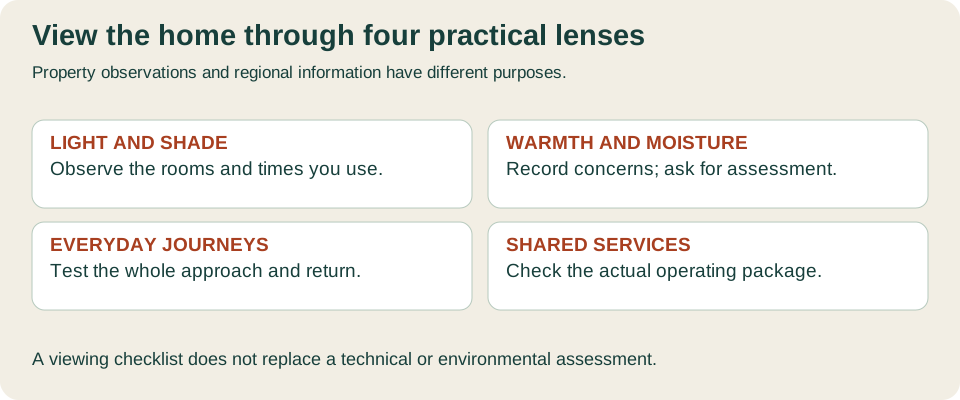
Choose the activities and conditions most likely to change your shortlist. You might need a different time of day, an ordinary shopping trip, a discussion of equipment or a professional inspection. Set a realistic aim for the visit and record what it can and cannot establish. Keep technical assessment separate from simply spending more time looking around.
Update the property comparison workspace with observed, reported and checked information in their separate fields. The decision guides help when a new finding changes an assumption. This guide and its linked primary sources were checked on 9 November 2026; no address-specific comfort, safety or environmental finding is claimed.
Keep a simple visit log with one line for each room or route checked. Add the source of any explanation supplied by someone else and the next observation or enquiry required. This allows two household members to compare notes without confusing a shared impression with a finding established for the property by an appropriate professional.