Find the task behind the delay and plan the next step
Manage a delayed Costa del Sol property purchase with a dependency log for documents, finance, inspections, signing arrangements and revised dates.
At a glance
- Separate target dates from contractual commitments.
- Identify each missing task, its owner and dependent decisions.
- Have changes and consequences explained before acting.
A Costa del Sol property purchase can have several moving parts at once: records, finance, inspection, contractual decisions, signing arrangements and the transfer of money. When one part slips, “we are waiting for paperwork” is rarely enough information to plan around. A useful update identifies the missing item, who must act, what depends on it and which date is affected.
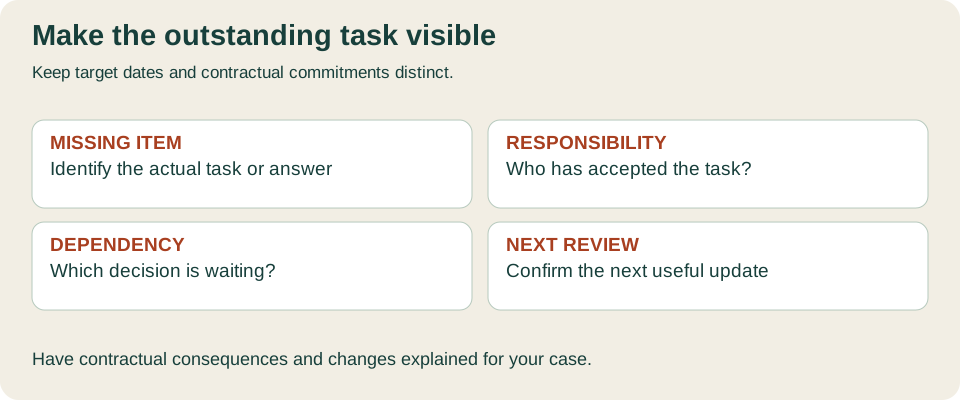
This guide offers a way to manage those updates. It does not set a universal completion timetable or decide the consequences of missing a contractual date. Use the purchase dependency log with your buying-process checklist. Have your legal adviser explain the commitments and available choices in the transaction before relying on a revised plan or changing other arrangements.
Separate a target date from an agreed obligation
Record where each date came from. An agent’s suggested week, a booked flight, an inspection appointment and a date in a signed agreement have different roles. Keep the document and explanation with each commitment. Ask which event starts a period, what must happen by its end and who is responsible. Do not describe every date in a shared email as a deadline with the same consequences.
The private purchase contract guide and reservation guide supply questions for that discussion. If circumstances change, have the effect on your position explained promptly. A verbal expectation of flexibility is not a reliable basis for assuming signed terms have changed. Keep the proposed alteration and the confirmed position separate in your notes.
Turn the delay into a specific task
Replace “documents outstanding” with the record requested, recipient, request date and next follow-up. Record whether it has been requested, supplied, checked or accepted for the relevant purpose. Arrival in an inbox is progress, but does not establish that an adviser has completed the review. Identify any translation, updated version or related material needed to answer the original question before marking the issue resolved.
Use the document reading examples to separate record purposes. Where ownership, descriptions or authority remain unclear, assign the question to the appropriate adviser and retain their response. Avoid creating an optimistic date by treating every open item as an afternoon’s work. Some tasks depend on information or appointments that have not yet been confirmed, and the people responsible should explain those dependencies.
Map dependencies rather than counting emails
For each issue, ask what cannot happen until it is resolved. An inspection may need access; a quotation may depend on that inspection; a funding decision may need buyer and property information. Some tasks may proceed in parallel, but the responsible people should confirm which ones. An expanding email chain does not necessarily show which task is controlling the next decision or whether anyone has accepted it.
The professional roles guide identifies appointments and deliverables. Keep one coordinating list with a named owner for each question rather than assuming everyone copied into an email is working on it. The decision guides turn unexpected answers into the next enquiry. Keep the complete issue alongside the short status entry so a concise update does not conceal an important qualification.
Keep finance progress distinct from the purchase date
Ask the lender or appointed intermediary which stage has been reached and which items remain. Distinguish an initial discussion, valuation, lender decision and the documentation and signing steps relevant to the loan. A positive conversation or property inspection should not be treated as confirmation that all funding conditions are satisfied. Keep finance progress attached to the transaction it must support and have proposed timing explained.
The Notariado mortgage guidance explains pre-signing information and advice stages. Ask the lender and notary about applicable timing instead of trying to compress it around travel bookings. Use the finance conditions guide and mortgage valuation guide for remaining requirements and changed assumptions. Do not transfer a timetable from a different buyer’s loan into your own plan without confirmation.
Track inspection findings and follow-up access
An initial inspection can prompt more focused assessment or further information requests. Record what was inspected, exclusions and what the professional needs next. If access was limited or equipment could not be checked, keep that limitation visible. Ask when a report or clarification is expected and which decision it informs. A report received is not necessarily an issue resolved, especially where it recommends more investigation.
The technical inspection guide helps agree scope. For a new development, the new-build inspection resource organises observations and handover questions. Do not convert a contractor’s availability or seller’s intention into verified completion of work. Record the evidence and checks required before relying on the proposed result, and who has agreed to provide or assess them.
Check authority, attendance and signing arrangements
Ask who must attend, which identification or authority is required and how documents will be prepared. If someone is abroad, clarify the signing route before the target week. A power of attorney needs checking by the professionals relying on it. An appointment booked in one country does not itself establish that the resulting document meets the requirements of the intended transaction in Spain.
The power-of-attorney guide and selling from abroad guide cover preparation. Authority issues differ from diary problems: changing a meeting time may not resolve missing evidence. Ask for a realistic sequence and confirmation of the next task without assuming an external office’s response time. Retain the explanation of what remains necessary before travel or another appointment becomes useful.
Use a fictional log to ask better questions
Imagine a fictional resale with three open tasks: an updated record requested by the lawyer, a lender clarification and a follow-up inspection needing access. The buyer hopes to complete in two weeks. That hope does not establish that the tasks fit the period. An informative update states who owns each task, what is missing and whether later steps depend on the answer.
The lawyer may need the record before advising, the lender explains its remaining requirements, and the inspector needs an agreed visit. Put each on a separate worksheet line. Mark the proposed date unconfirmed and ask the relevant parties to assess it. This is an invented workflow, not a typical duration, real case or evidence that a particular participant is responsible. Use its structure while replacing every assumption with the actual position.
Review a revised proposal before acting
If a date change is proposed, record the exact request and take it to your adviser. Ask about existing commitments, payments, conditions and connected arrangements. Have the agreed position recorded appropriately. An email suggesting another week may not answer those questions. Nor should a missed target automatically be treated as establishing a right to withdraw, retain money or receive a refund without the relevant advice.
For disputes or threatened missed commitments, use the contract dispute guide and obtain case-specific advice. The UK government’s Spain property guidance supplies background on independent legal advice. Keep the immediate objective clear: understand the position before sending a message attempting to change the deal. Retain both the request and the response rather than summarising them from memory later.
Align the move and payments with confirmed information
Review flights, accommodation, removals, insurance, utilities and existing home arrangements when the sequence changes. Identify flexible bookings and the cost of altering them. Separate intended handover from hoped-for furniture delivery or work. The move-in planner captures associated spending without turning a provisional date into a settled one. Record which booking decisions can wait and which require attention now.
Have payment method, recipient details and timing confirmed through the agreed professional process; pressure should not replace those checks. Use the first-month ownership guide when handover is confirmed. Finish updates with the next action and review point. Primary sources were checked on 9 November 2026 and publication prepared on 10 November 2026. No individual contractual, funding or completion outcome is predicted.