Budget for the home you can actually move into
Plan furniture, appliances, deliveries, installation and initial setup for a Costa del Sol home, using a clear fictional budget and a downloadable worksheet.
At a glance
- Separate move-in spending from purchase costs and annual ownership.
- Check inclusions, measurements and the complete delivery route.
- Replace the fictional scenario amounts with your own itemised quotations.
The purchase budget gets you to ownership. The move-in budget gets the home ready for the way you intend to use it. For a Costa del Sol apartment, townhouse or villa, that second stage can include furniture, appliances, installation, deliveries, utility arrangements and the practical work of making the property usable. Keeping it separate makes the complete commitment easier to see.
Use the room-by-room move-in workbook before placing orders. It works alongside the buying cost calculator, ownership budget and first 30 days after purchase guide. The examples below are invented arithmetic scenarios, not current supplier prices or a recommended spending level.
Confirm what will already be there
Start with the agreed sale information. Which furniture, appliances, fittings, access devices and other items are included? What is their stated condition, and what will you inspect before completion? A listing photograph showing a furnished room does not establish that everything pictured will remain. Keep a written list so later purchases are based on the actual agreement.
For a new home, match your list against the agreed specification rather than a show-home display. The new-build purchase guide helps you organise those questions. For a resale, ask about manuals, warranties and relevant service information where available, without assuming that an old appliance will meet your requirements simply because it is included.
Divide the work into four budgets
Use four separate categories: immediate safety or condition matters needing suitable professional attention; essentials for ordinary occupation; optional improvements; and later replacements. This lets you identify what must be ready for the first visit and what can wait. It also stops a furniture allowance from quietly absorbing building work that should be assessed and priced separately.
Use the renovation budget guide for work to the property, and keep any quotations attached to the correct category. An attractive package price is less helpful if it excludes installation or depends on measurements you have not checked. Compare proposals by what is delivered, fitted, removed and left ready for use.
Measure the whole delivery route
Measure the space where the item will stand and the route it must travel. Include doors, corners, stairs, lift access and the approach from the unloading point. Confirm the supplier’s own access requirements before ordering. A large sofa that fits the living room may still be difficult to bring through the entrance or up the shared staircase.
Ask about permitted delivery arrangements where shared property is involved. The community ownership guide provides context for clarifying the building’s practical rules. Record whether a proposed service includes carrying items into the home, assembly, packaging removal or only delivery to a stated point.
Plan the essential rooms first
For each room, list the activities the home must support. Bedrooms may need beds, suitable bedding, storage and light control. A kitchen needs the equipment relevant to your own routine, not every optional gadget. Add cleaning equipment, basic tools appropriate to ordinary household use and the small items that can be easy to overlook while choosing large furniture.
Think about accessibility and everyday handling as well as appearance. Check circulation around beds, furniture heights and where frequently used items will be stored. If you expect visitors, record their practical needs separately. The holiday versus permanent-home guide helps you decide how the intended pattern of use changes the shopping list.
Use a transparent example instead of a generic allowance
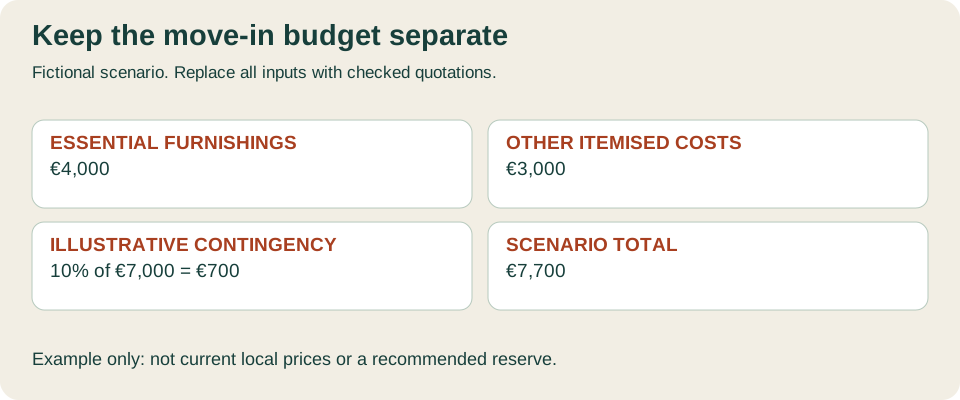
| Category | Assumed amount |
|---|---|
| Essential furnishings | €4,000 |
| Appliances | €1,200 |
| Delivery and assembly | €500 |
| Initial household equipment | €300 |
| Installation and setup | €600 |
| Initial cleaning | €400 |
| Subtotal | €7,000 |
| Illustrative 10% contingency | €700 |
| Scenario total | €7,700 |
The contingency percentage is simply an input to this example. It does not establish an adequate reserve for your home. Add excluded building work, travel or other items separately where relevant, and check whether your real quotations include applicable taxes. Keeping a visible exclusions list is as important as adding up the amounts you already know.
Schedule utilities and connection work
Identify what needs changing, connecting or checking for electricity, water, communications and other relevant services. Ask providers about the actual address, current equipment, appointment requirements and the person who must attend. Do not build the whole move-in plan around an assumed connection date that has not been confirmed.
The utilities handover guide helps you organise the information. Separate one-off connection or installation expenditure from recurring service bills in the ownership budget. For remote working, test the proposed setup and consider the household’s tolerance for interruption before committing to a routine that depends on it.
Check comfort before buying equipment
Observe the building’s shading, ventilation and existing heating or cooling arrangements before selecting additional equipment. Ask a suitable professional about installation, capacity, electrical requirements and any relevant permissions. Do not treat buying an appliance as the complete solution to a building or service problem that has not been assessed.
Use the energy and comfort guide to frame that discussion. Check how proposed equipment will be maintained and where controls, filters or service points can be reached. Ask what documentation and user information will be provided when work is finished, and retain it with the home’s operating records.
Allow for the way the home will be used
A home used for short personal visits may need different storage and arrival arrangements from one occupied throughout the year. List what must be ready when you arrive and what can safely remain switched off or stored during absences, following the relevant equipment instructions. If letting is proposed, prepare a separate operating brief with your adviser and manager; a personal furnishing list does not settle the requirements or costs of a rental business.
Make a remote installation plan
If you cannot attend deliveries, agree who can accept items, identify damage, check the order and report what arrived. Give that person the current order list and the limits of their authority. Record how missing parts, unsuitable items or incomplete installation will be handled. A delivery confirmation alone does not establish that the home is ready for occupation.
The remote-management guide helps you define that arrangement. Keep keys, access instructions and private contact details in an appropriate private record. Share only what each provider needs for the agreed task, rather than distributing a complete household information pack to everyone involved.
Compare quotations with the same inclusions
Ask for an itemised written proposal stating the work, materials, delivery, installation, removal, timing and payment arrangements. Keep the accepted version and record agreed changes. The Junta’s guidance on written service quotations offers consumer context; the applicable position depends on the service and circumstances.
Use the contractor agreement guide when work is involved. A cheaper headline amount may cover fewer tasks or different assumptions. Clarify those differences before choosing, and keep professional investigation and any required approvals separate from the commercial proposal to carry out the work.
Finish with a usable handover record
Keep a record of what was ordered, delivered, installed, checked and still outstanding. Retain the relevant receipts, instructions and warranty information. Walk through the home using your own first-day routine: entry, lighting, hot water, sleeping, cooking and communication. Record gaps while there is still time to resolve them before an extended stay.
Move confirmed recurring costs into the ongoing ownership budget and future work into the maintenance plan. Sources and linked service guidance were checked on 9 November 2026. The worksheet and scenario are original planning aids; they do not quote a supplier, set a local price benchmark or guarantee that a particular budget will be sufficient.